
It usually starts with an email from someone outside engineering. A large prospect's security team wants your SOC 2 report before it signs, or your payment provider asks which PCI DSS self-assessment you file. Within a week the request has landed with the people who run the code and the infrastructure. From the outside, SOC 2 vs PCI DSS looks like a paperwork question. It isn't, because both end up asking what your system does with data and whether you can show it.
One boundary first. Your development team can't declare the company compliant with either. A CPA firm examines and reports on SOC 2, and PCI DSS is validated through an assessor or a self-assessment questionnaire, whichever your acquirer or the card brands require. This guide covers the other half of the work: what your team builds and changes, so that whoever does the checking has less to find.
SOC 2 vs PCI DSS: what's the difference?
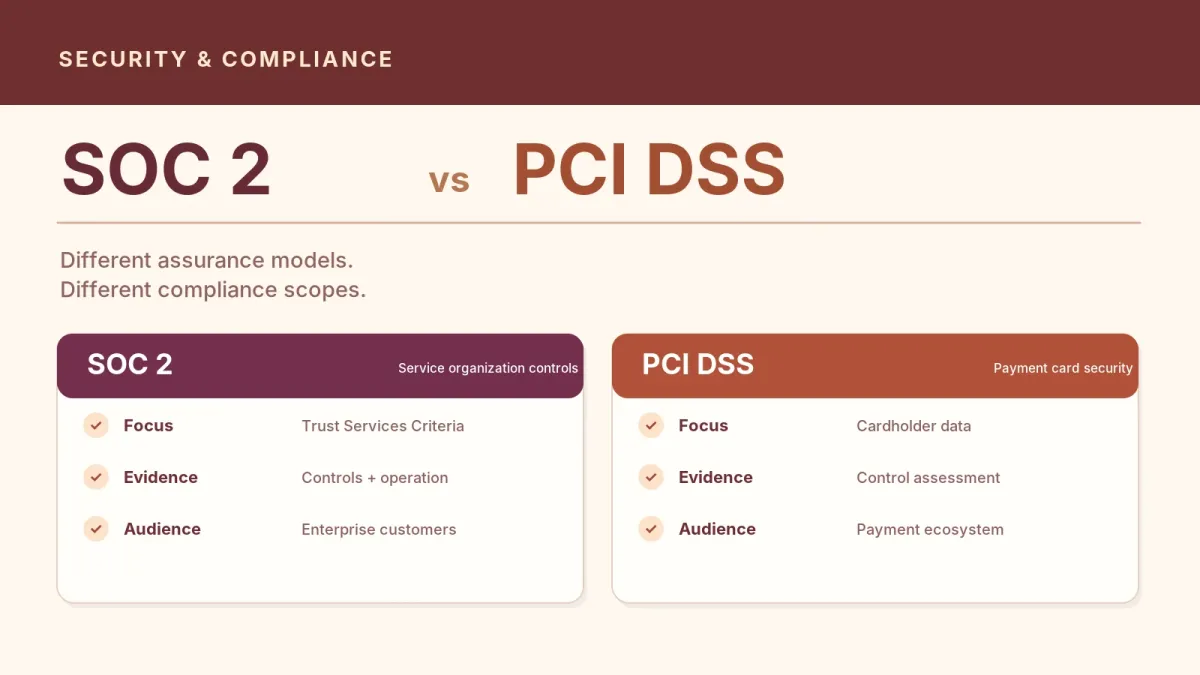
SOC 2 is an examination, performed by a CPA firm, of a service organization's description of its system and of its controls over security, availability, processing integrity, confidentiality or privacy. PCI DSS is the card industry's baseline of technical and operational requirements for anyone who stores, processes or transmits cardholder data, or could affect the security of the environment that holds it.
The AICPA's SOC 2 guide calls it an "assertion-based examination of a service organization's description of its system and its controls," and the examination measures those controls against the Trust Services Criteria that the AICPA's Assurance Services Executive Committee sets. The PCI Security Standards Council (PCI SSC) describes PCI DSS as "a baseline of technical and operational requirements designed to protect payment account data."
For an engineering team, the practical difference follows from those two descriptions. SOC 2 starts from a system you describe, so you have a say in its boundaries. PCI DSS applies a fixed set of requirements to the systems that handle card data and to the systems connected to them, so your main lever is how far card data spreads and what can reach it. The table below is our own comparison, built from the AICPA and PCI SSC sources linked in this guide.
| SOC 2 | PCI DSS | |
|---|---|---|
| Who sets it | The AICPA, whose Trust Services Criteria the examination uses | The PCI SSC |
| Who asks for it | Customers and business partners of a service organization | Card brands, acquirers and payment facilitators |
| What gets examined | The system you describe and the controls in it | Every system that stores, processes or transmits card data, plus the systems connected to it or able to affect it |
| Who does the check | A CPA firm | A Qualified Security Assessor (QSA) or your own self-assessment questionnaire (SAQ), as the enforcing entity requires |
| What you end up with | A SOC 2 report that you share with customers | Validation documents for your acquirer or the brands, such as a completed SAQ |
| How you narrow it | You set the boundary of the system the description covers, agreed with your auditor (our reading) | You keep card data out of systems, mainly through tokenization and network segmentation |
Do you need SOC 2, PCI DSS or both?
It depends on who's asking, and the two requests come from different directions.
SOC 2 comes from your buyers. The AICPA notes that "customers and business partners often request a SOC 2 report from the service organization."
PCI DSS comes from the payment side. In a post from January 2025, the PCI SSC says plainly that it "does not define compliance requirements for any organization or set compliance validation responsibilities." Validation requirements, it explains, are "set by brands, acquirers, payment facilitators, etc., which are often referred to as compliance enforcing entities."
So an early product that never touches a card number, and that no customer has asked for a report, may need neither yet. A SaaS product that takes card payments and sells to larger companies often ends up with both, on different timelines. That's the order we plan for in fintech and digital banking builds. PCI DSS for card data goes in as a design input from the first sprint, and SOC 2 joins once customers or a partner bank ask for a report.
If your product also handles protected health information, HIPAA is a separate regime with its own rules, which our guide to HIPAA-compliant software development covers.
What does a SOC 2 examination look at from the engineering side?
The auditor tests the controls you describe against the Trust Services Criteria, so engineering's job is to have controls that exist, that work, and that leave a record someone can check later. The criteria cover five categories: security, availability, processing integrity, confidentiality and privacy.
Two things about the examination shape the build more than any single control does. The first is that it starts from your own description of the system. If the architecture diagram is two years old, or nobody can list the cloud accounts and outside services that make up production, the description is wrong before testing begins. Keeping that inventory current is engineering work, and it's often the first gap a team finds.
The second is that the report rests on evidence the system produces while it runs. Approvals should live in pull requests, access changes should go through your identity provider with a record attached, and an alert should show who saw it and what they did. When the product and the pipeline record these things as part of normal work, you can export the evidence. When they don't, someone rebuilds the history by hand from chat threads and memory, and that tends to be where findings come from. So we treat SOC 2 compliance for SaaS as part of how the platform is built. (That's our view from the engineering side; the AICPA criteria themselves are the reference, and your auditor decides what counts as evidence.)
What does PCI DSS cover, and what does "in scope" mean?
PCI DSS applies to entities that "store, process, or transmit cardholder data (CHD) and/or sensitive authentication data (SAD) or could impact the security of the cardholder data environment (CDE)," in the PCI SSC's words. The CDE is the part of your environment where card data lives and moves, and scope reaches well past it.
The PCI SSC's scoping supplement from May 2017 says scoping means "critically evaluating the CDE and CHD flows, as well as all connected-to and supporting system components." Its own example of a connected system is an authentication server. By the same logic, a deploy pipeline that pushes code into the CDE can fall in scope, and so can a log collector that reads from it, even when neither one stores a card number.
The network layout matters just as much. The same supplement warns that "without adequate network segmentation (sometimes called a 'flat network') the entire network is in scope of the PCI DSS assessment." In a cloud product with one shared VPC and open security groups, that can be every service you run.
The current version of the standard is PCI DSS v4.0.1, which the PCI SSC lists in its document library. The January 2025 PCI SSC post linked above notes that requirements 6.4.3 and 11.6.1, among others, took effect on 31 March 2025. In our summary, both concern the payment page as it runs in the customer's browser.
How do engineering teams shrink PCI scope?
Keep card numbers off your systems, then prove that the systems left over can't reach them. PCI scope reduction is mostly an architecture decision. It's much easier to make before launch, because after launch card data has often spread into logs, queues and support tools.
- Map where card data enters, moves and rests. Draw the data flow first: the checkout page, the API call that creates a charge, webhooks, support tooling, analytics and logs. Card numbers can turn up in request logs and error reports as well as in a database.
- Let the processor collect the card. With a hosted payment page or the processor's embedded fields, the card number goes straight to the processor and your servers receive a token instead. The integration method you choose also decides which self-assessment questionnaire you're likely to file.
- Treat what remains as the CDE, and isolate it. Whatever still stores, processes or transmits card data goes into its own network segment, with a short, written list of connections in and out. Everything else then has a chance of staying out of scope.
- Check that nothing outside can turn a token back into a card number. The PCI SSC's tokenization guidelines, published in August 2011, describe tokenization as replacing the primary account number (PAN) with "a surrogate value called a 'token.'" The same guidance treats the tokenization system itself, "including de-tokenization and PAN storage," as part of the CDE. Before any system can be called out of scope, "it must first be verified that the system/network is not connected to the CDE and that it cannot retrieve or access PAN or other account data." An internal admin tool that can call a de-tokenize endpoint is in scope, whatever it's called.
- Control the scripts on your payment page. Hosted fields still load inside a page you serve. In the January 2025 update, the PCI SSC added an eligibility criterion for SAQ A: merchants must "confirm their site is not susceptible to attacks from scripts that could affect the merchant's e-commerce system(s)." To meet it, our usual approach is an inventory of every script the page loads, a content security policy, and a way to notice when a script changes.
- Confirm scope again at least once a year, and after architecture changes. The scoping supplement says scope should be confirmed "at least annually and prior to the annual assessment." A new service that subscribes to payment events can connect to the CDE in a single sprint, so we re-check scope whenever the data flow diagram changes.
None of this makes PCI DSS go away. The 2011 guidance is direct about it: tokenization solutions "do not eliminate the need to maintain and validate PCI DSS compliance, but they may simplify a merchant's validation efforts by reducing the number of system components for which PCI DSS requirements apply." The realistic goal is fewer components to secure and evidence.
If you route payments through more than one provider, the vault and orchestration layer change the scope picture, and our post on payment orchestration covers that case. In retail and ecommerce systems we apply the same idea to orders and customer records, which hold tokens and never card numbers.
What changes in the build for each?
Most of the work is the same engineering hygiene, aimed at different evidence. SOC 2 looks for controls operating across the system you describe; PCI DSS looks for them in and around the CDE, and rewards you for keeping the CDE small. The table is our own analysis of where each change usually comes from.
| Build change | What drives it |
|---|---|
| A data flow diagram and an accurate system description | Both. The SOC 2 examination starts from your description of the system, and PCI scoping starts from where card data flows. |
| Named accounts, MFA and periodic access reviews | Both. For SOC 2 across the described system; for PCI DSS across everything in or connected to the CDE. |
| Change control and code review | Mainly SOC 2, across the whole product. Under PCI DSS it matters most for changes that reach the CDE. |
| Logging and monitoring | Both. Each wants to see who did what and when, and whether anyone noticed. |
| Payment page script control | PCI DSS: requirements 6.4.3 and 11.6.1, and the SAQ A script criterion. |
| Tokenization and network segmentation | PCI DSS, as the main way to keep scope small. |
| Backups and tested recovery | SOC 2, when availability is one of the categories in the report. |
This is the part we do. In SaaS platform work that closes security-review gaps, we help design and implement the technical controls relevant to a client's SOC 2 readiness program. We work with their auditor so the controls are implemented correctly. We aren't a SOC 2 audit firm and we don't provide audit or attestation services. For card data, we aim to keep it out of as much of the system as we can. The scope is then confirmed by your QSA or, if you self-assess, by your own questionnaire, as your acquirer requires.
FAQ
Does using Stripe or another processor make us PCI compliant?
No. A processor can reduce how many PCI DSS requirements apply to you, but the obligations stay, and your acquirer or the card brands decide how you validate. SAQ A, for example, is for merchants whose account data functions are "completely outsourced to PCI DSS validated and compliant third parties" and who keep account data only on paper reports or receipts.
Can a software company get SOC 2 for us?
No. The report comes from a CPA firm, and the AICPA's guide is written for "CPAs in public practice engaged to perform SOC 2 and SOC 3® examinations." A development partner can build and fix the controls the examination tests, and that's our scope: we work alongside your auditor, and the report is the auditor's to issue.
Can't we buy a compliance tool and be done?
A tool can gather evidence, track policies and remind people that an access review is due. It can't make a control exist. If production changes skip review, or a support tool can de-tokenize card numbers, that gap stays a gap whether or not a tool records it, because the auditor or assessor examines the control itself. The system still has to be built right.
Is network segmentation required by PCI DSS?
No. The 2017 scoping supplement says isolating the CDE from the rest of the network "is not a PCI DSS requirement." It also calls segmentation "one method that can help reduce the number of system components in scope." The other method is keeping card data out in the first place, and the two work together: the CDE you can't remove is the one you segment.
Are the SOC 2 criteria changing?
Possibly, from 2027. The AICPA's Assurance Services Executive Committee "has issued exposure drafts of proposed revisions to the Trust Services Criteria (TSC) and Description Criteria (DC) used in SOC 2 examinations" (AICPA, 26 October 2026). They're proposals with no effective date on the page, which is why this guide shows its last-updated date.
Planning compliance-driven engineering work
If a security review or a payment provider's question has landed on your team, a discovery call is a sensible first step. We'll go through who is asking, where customer data and card data flow in your system, and what needs to change in the build, while your auditor or assessor stays the one who signs off.
Buttons: "Book a Technical Discovery Call" → /contact · "Get a Project Estimate" → /project-estimate